
Professional Self-Loading Garbage Truck Technical Whitepaper: Heavy-Duty Chassis Integration, Robotic Arm Kinematics, and High-Efficiency Solid Waste Management Solutions
Introduction: The Efficiency Revolution and Procurement Strategy in Municipal Solid Waste Logistics
In the era of modern urbanization, the efficient, environmentally compliant, and cost-effective collection and transport of Municipal Solid Waste (MSW) serve as a core metric for evaluating municipal infrastructure capabilities. For global municipal sanitation departments, urban infrastructure contractors, and commercial fleet operators, traditional manual loading or low-efficiency collection models can no longer meet the escalating demands of modern waste management.
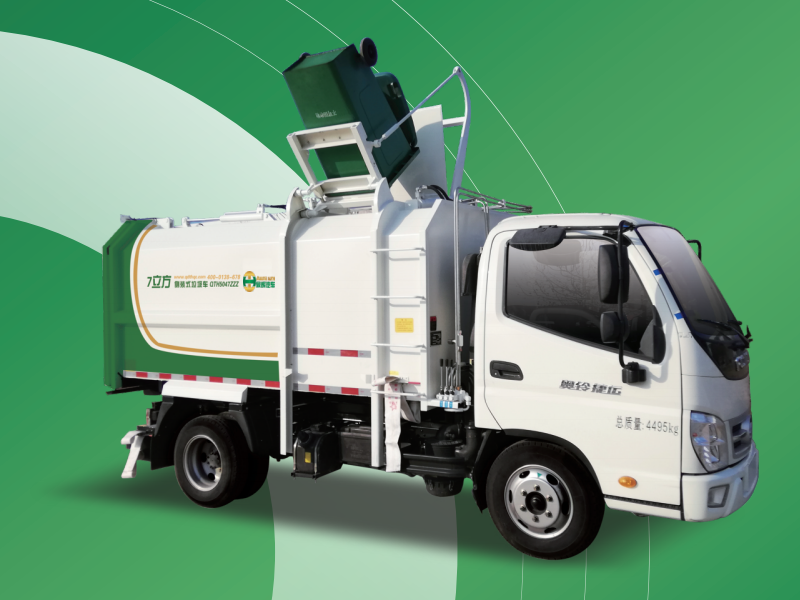
As the cornerstone of modern solid waste logistics systems, Self-Loading Garbage Trucks (Side Loaders / Skip Loaders) have become the preferred vehicle type for global fleet procurement, driven by their highly automated mechanical arm lifting systems, powerful hydraulic compaction architectures, hermetically sealed contamination-prevention designs, and superior single-operator efficiency.
As a benchmark brand specializing in high-grade commercial vehicle manufacturing, ckautomfg is dedicated to seamlessly integrating world-class chassis engineering, advanced fluid dynamics control, and anti-wear metallurgy. This technical whitepaper provides an in-depth analysis of the technical specifications of high-standard self-loading garbage trucks across four core dimensions: mechanical structural engineering, vessel compaction matrices, hydraulic fluid dynamics, and Total Cost of Ownership (TCO), helping your fleet maximize operational productivity.
1. Mechanical Structural Engineering & Bucket Lifting Architecture
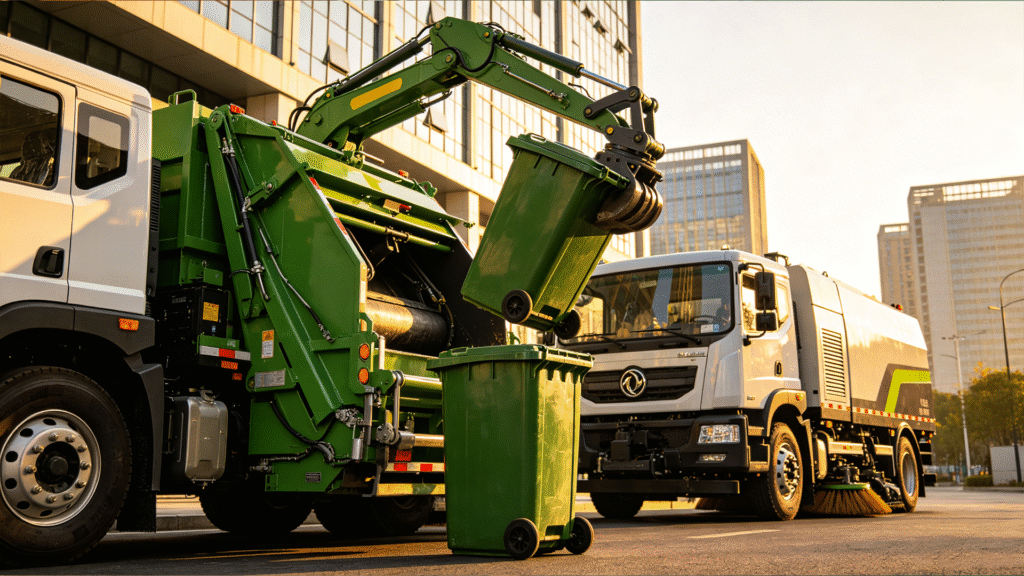
The core productivity of a self-loading garbage truck relies on its front- or side-mounted mechanical lifting system. This mechanism must execute precise grasping, smooth elevation, complete inversion/tipping, and safe reset of waste containers within exceptionally short operational cycle times.
1.1 Modular Comb-Type and Trunnion-Style Composite Lifting Systems
To fully accommodate international waste container standards (such as EN 840 compliant 120L, 240L, 660L, and 1100L plastic and metallic waste bins), ckautomfg utilizes a composite lifting architecture combining high-strength modular comb-lifts and heavy-duty trunnion lifts.
High-Strength Low-Alloy (HSLA) Steel Skeleton: Primary lift arm components are manufactured from HSLA steel using precision laser cutting and CNC bending. This significantly reduces tare weight while ensuring high-frequency continuous operation under rated lift capacities (typically 300 kg to 800 kg) without structural fatigue or torsional deformation.
Hydraulic/Pneumatic Auxiliary Locking Mechanisms: Before the bin reaches its tipping point, automated mechanical locking latches engage to firmly secure the container rim, completely eliminating the risk of bins dislodging and falling into the hopper when tipping high-density organic waste or heavy construction debris.
1.2 Four-Bar Linkage Motion Optimization and Kinematic Simulation
The trajectory of the lifting mechanism directly influences spillage risks during tipping. Through Computer-Aided Engineering (CAE) and multi-body dynamics simulation, we have optimized the Four-Bar Linkage System:
Vertical Motion at Initial Lift: During initial elevation, the container maintains a near-vertical path, preventing loose waste or liquids from sloshing out before reaching the hopper opening.
High-Angle Complete Discharge: The mechanism achieves a maximum tipping angle of 135° to 150° at its peak, assisted by a vibration-clearing function to ensure sticky materials (such as food waste or wet foliage) slide out completely, eliminating bin-bottom residue.
2. Vessel Compaction Systems & Anti-Wear Metallurgy
A vehicle’s payload capacity directly determines fleet operational cycle efficiency. The ability to highly compress loose municipal solid waste is a crucial indicator of a self-loading garbage truck’s engineering value.
2.1 Scraper, Slider, and Push-Plate Composite Compaction Architecture
At the junction of the loading hopper and the main vessel, the vehicle features a heavy-duty scraper and slider compaction system driven by large-bore high-pressure hydraulic cylinders:
High-Efficiency Bag Breaking and Shearing: The scraper first aggressively grabs and shears loose cardboard boxes and plastic bottles to break open bags, after which the slider pushes the material downward into the main chamber.
High Compression Ratio: Inside the main vessel, a heavy-duty push-plate operating under automated backpressure control retracts incrementally. Through progressive layer-by-layer compaction, it achieves volumetric compression ratios of up to 3:1 to 5:1. This drastically increases payload tonnage per trip, significantly cutting fuel consumption and time expenditures associated with trips to transfer stations.
2.2 High-Grade Anti-Wear Steel and Heavy Corrosion-Protection Metallurgy Standards
Because solid waste exerts intense friction on the inner vessel walls during compaction and unloading, and because leachate possesses strong acidic and alkaline corrosive properties, advanced material selection is vital:
NM450 / Hardox Anti-Wear Steel Plates: The bottom floor of the vessel and high-wear sliding channels are constructed entirely from high-grade anti-wear steel plates with high Brinell hardness (HBW ≥ 450), ensuring an exceptionally long service life against abrasion caused by hard debris (such as glass and metal fragments).
Corten Steel and Dual-Layer Heavy Epoxy Coatings: The exterior body shell utilizes high-strength weather-resistant Corten steel, while the interior is sprayed with thick-film coal-tar epoxy or polyurethane anti-corrosion primers, physically isolating the metal substrate from acidic leachate attack.
3.Hydraulic Fluid Dynamics & Intelligent Electronic Control Architecture
All operational sequences of the self-loading garbage truck—including mechanical arm elevation, locking, scraper compaction, push-plate unloading, and tailgate actuation—rely on high-efficiency, precision-engineered hydraulic and electronic control systems.
3.1 Load-Sensing Proportional Hydraulic Systems
High-Displacement Piston and Gear Pump Matrices: Power is supplied via the commercial truck chassis Power Take-Off (PTO) without drive-line losses to power the high-pressure hydraulic pumps, establishing a rated system working pressure exceeding 21 MPa.
Proportional Multi-Way Valves and Stepless Speed Control: Core hydraulic valve blocks feature industry-leading proportional control technology, enabling precise regulation of hydraulic fluid flow rates. This guarantees smooth, shock-free start and stop motions for the mechanical arm, eliminating hydraulic fluid hammer that destroys cylinder seals and hose fittings.
Intelligent Thermal Management and Filtration: The hydraulic system integrates a large-capacity oil reservoir, high-precision return-line oil filters, and forced air-cooling heat exchangers, ensuring hydraulic oil temperatures remain within optimal operating ranges even under tropical or high-intensity continuous duty cycles.
3.2 CAN-Bus Systems and Ergonomic Human-Machine Interfaces
Automated Cycle Control: The vehicle electrical architecture is built on a CAN-Bus system, integrating multi-channel Hall sensors and limit switches to support one-touch fully automated compaction cycles.
Dual Operating Interfaces: Inside the cab, a high-definition color LCD touch display provides real-time monitoring of cylinder pressures, payload fill rates, and diagnostic alerts. Meanwhile, waterproof and dustproof wireless remote controls and manual pilot levers are installed on both sides of the vehicle body for precise, safe close-range adjustments.
4.Hermetic Sealing & Leachate Management
In international municipal tenders, secondary contamination risks (such as odor dispersion, liquid dripping, and refuse blowing in the wind) serve as non-negotiable disqualification factors.
4.1 Synchronized Automatic Top Covers and Dual-Layer Sealed Tailgates
Intelligent Hydraulic Top Covers: The hopper opening features dual-folding hydraulic top covers. The covers automatically fold open in synchronization with the lift arm cycle and automatically close and latch shut once tipping is complete, ensuring a 100% fully sealed container during transit to prevent spillage.
Dual-Layer EPDM Rubber Gaskets: The interface between the body and tailgate incorporates recessed retention grooves fitted with oil-resistant, anti-aging dual-layer EPDM rubber gaskets. Coupled with a multi-point hydraulic hook locking mechanism, this achieves a zero-leakage standard under full-load compaction pressure.
4.2 Independent High-Capacity Leachate Collection Systems (Sump Tanks)
Solid waste releases substantial amounts of liquid (leachate) when subjected to high-pressure compaction.
Dual-Directional Drainage Channel Design: Angled drainage channels are positioned at the base of the vessel body and front of the loading hopper, rapidly channeling free-flowing liquids into a high-capacity stainless-steel leachate collection tank located under the chassis frame.
Anti-Leakage Discharge Valve Configuration: The collection tank features a large-diameter discharge ball valve and quick-drain coupling, enabling fleet personnel to perform centralized, environmentally compliant drainage upon returning to the depot, protecting urban road sanitation.
5.Total Cost of Ownership (TCO) & Fleet Procurement Strategy
For B2B fleet operators, the initial purchase price represents only a fraction of total vehicle lifecycle expenditures; Total Cost of Ownership (TCO) dictates long-term Return on Investment (ROI).
5.1 Labor Cost Reduction via Single-Operator Efficiency
Traditional garbage trucks typically require one driver teamed with two or three loaders for manual bin attachment. Highly automated self-loading garbage trucks enable a single driver to complete refuse collection across entire streets independently from inside the cab or via side-mounted remote controls, cutting direct labor costs by over 50% and mitigating operational challenges caused by labor shortages and rising wage rates.
5.2 Global Chassis Compatibility and Standardized Wear Components
ckautomfg superstructures strictly adhere to global Bodybuilder Guidelines established by major commercial vehicle manufacturers, offering seamless integration onto leading commercial chassis platforms (such as ISUZU, Dongfeng, Foton, FAW, and others).
Consumables like hydraulic oil filter elements, seal kits, and high-pressure hoses utilize standardized global specifications.
Fleet maintenance teams can quickly procure replacement modules locally, reducing unscheduled vehicle downtime to absolute minimums and guaranteeing high municipal contract compliance.
Conclusion: Partnering with ckautomfg to Empower Global Municipal Solid Waste Logistics
As an indispensable asset in modern municipal solid waste logistics, the technical sophistication and reliability of a self-loading garbage truck directly affect urban ecological standards and corporate commercial reputation. By seamlessly combining high-strength anti-wear metallurgy, precision four-bar kinematics, load-sensing hydraulic engineering, and strict hermetic anti-leakage designs, ckautomfg delivers benchmark-grade liquid and solid waste logistics solutions featuring outstanding uptime and low TCO to global municipal clients.
We stand ready to provide comprehensive technical parameter sheets, CAD engineering blueprints, tiered B2B pricing packages, and professional global containerized or Ro-Ro ocean freight logistics solutions.
Contact our international commercial operations team today to request your customized self-loading garbage truck procurement package, and let elite commercial engineering drive your municipal fleet forward!